Each year, the Trinidad+Tobago Film Festival (TTFF) selects a visual artist whose work expands how we think about storytelling, memory, and place. For 2025, we are proud to announce Rodell Warner as the Festival Artist. A boundary-pushing visual artist and digital archivist, Warner’s work for TTFF/25 brings together over 15 years of personal creative exploration and a deep love for the Caribbean image. In this exclusive interview, Warner takes us inside his creative practice, his fascination with the archive, and the layered inspirations behind this year’s festival poster.
Tell us your name and what you do.
My name is Rodell Warner and I’m a visual artist. I make moving images – I work a lot with archival imagery; computational images; artificially generated images that I turn into moving images.
Tell us where your interest in archive began.
My interest in archives began around 2009. I was about 23 – I’d started working at an advertising agency in Port of Spain with 15 or so artists who were all older than me. A few of them, including Dave Williams and Richard Rawlins, would talk a lot about Trinidad and Tobago, and how much they love it and how much has changed and how much I don’t know about it!
At the time my focus was very outward. I was not looking at Trinidad in a very loving way – but they were, and it was kind of contagious. So, out of curiosity, wanting to know what they were talking about and also wanting to locate myself within the history of the place that they were talking about, I started looking for old images of Trinidad and Tobago online. I would use random search terms in Google, like ‘Trinidad shoes 1955’ or ‘Trinidad bed 1975’. I would just choose random words. And sometimes I would be focused about it – looking for performers, artists and musicians. But I would find all these really interesting images – things I was never exposed to before. And I started collecting them. I had a Tumblr blog at the time, called TooMuchEyes. It’s still up. And you can go to the page online and see what I saved from 2009 to around 2014. It’s just a lot of archival images of Trinidad and Tobago for the most part. That was my first archiving project and what got me into archives.
You were taking photographs for a while. What made you start experimenting with web-based works?
I would say around 2011-12 I was primarily a photographer. I liked to draw and I would make clothes, putting images onto t-shirts and things like that. But I had really fallen in love with photography and my first formal art projects were photography projects. I started experimenting with abstraction with the photos that I would make, and also with animating them. And through my blog, I met Trini-Canadian artist, writer and curator, Rea McNamara. She was very interested in the archival work I was doing, and also really interested in my experiments with animation. At the time she was studying niches and subcultures, and she was creating a series of art exhibitions, which was a series of parties. And she would invite different niches – artists from different subcultures to make artworks for these parties. One of the groups of artists that she invited was a group of net artists, people who were making web-based works. The artists that come to mind, specifically for what they were doing with their abstraction with web-based works, are Francoise Gamma, Lorna Mills and many others. Being exposed to what they were doing just really blew my mind! It made me interested in a kind of wildness or extravagance that’s possible online that’s not really possible in photography, which for me was very much a documentary medium at the time.
What is it about web-based work that appeals to you?
There are a number of things about web-based work that appeal to me. It’s its own medium, so there are things that you do when you’re working with the internet as your material that you don’t do when you’re working with drawing or video or photos. There are things that are possible in terms of time and experience – how a person encounters a space, a virtual space, and what you can do with media in that space.
My exploration of web-based work, or using the internet in my art practice began as an extension of putting images online but then became more about manipulating the space that it exists in online as well. And so now I have different ways that I make spaces online. They usually have to do with dealing with databases – archives of images and text. But for the last five years I have been learning about and experimenting with coding and making web-based works that really can’t function outside of the internet – they need to be run in a browser in real time for you to experience what I intend for you to experience.
Does the ephemerality of web-based work concern you?
Yes, absolutely. The ephemerality of internet-based works and the internet in general does concern me! A lot of ways that things work online become obsolete. A lot of ways that things can function when you make them are not guaranteed to function that way later on. Also, web-based works usually require the domain the work is hosted on to be maintained in order for that work to continue to exist in that way in the future.
My friends at TRANSFER Gallery have a new project where they’re hosting really large hard drives. They’re creating a community – of artists and people who are concerned with and care about art; an offline network using connected hard drives – called the TRANSFER Data Trust. The community is dedicated to preserving artworks. When an artwork is made, they take all of the protocols, the structures and the code and reproduce these architectures on hard drives and within this community. They are networked in such a way that when you upload things to the drive you’re responsible for – because everyone’s drives are periodically synchronized – your upload is copied onto everyone else’s drives as well. So if one fails, there are many redundant copies. That’s really what I’m seeing right now as the pioneering solution, or how people are working at preserving web-based works. I hope to be involved in the TRANSFER Data Trust in the future.
How do you hope audiences view/ interact with or react to the work?
A lot of the web-based works that I make – the intention is that they’re interactive. They also draw on archives. They usually involve a database of images that get selected. So what you see on screen is one thing, but behind the scenes there is a database or an archive that images are getting pulled from, that are getting displayed on the screen. There can also be databases of text, and sometimes combinations of text and image. And usually my intention is to create associations between the images and the text. Often I’m using randomness or pseudo-randomness to create unexpected or uncanny or novel combinations of images and text. The extent to which the images and the text are related varies from project to project. The extent to which the images in the database of images relate to each other varies. The extent to which a database of texts relates to each other varies as well. Usually my intention with the work – which involves randomness and interaction – the user or viewer is asked to generate or trigger new variations. It’s very much about creating associations between the works that are on display – the text and the images, or the collections of images – and the viewer’s own references.
This whole way of working is new to me; it’s very much an experiment, and what I’m really interested in right now is putting these various pieces of media together, with all their various messages and associations, and seeing how they play with each other; seeing what it means. One of the questions I have is, if I put 200 images that I have made over the last 15 years in a folder, what are the connections that can be made between these images? And if I add a layer of texts that I have written, how do those texts relate to the images? And if I present this to an audience of people who are connected to me in some way, what’s the level of overlap between my associations and those viewers’ associations?
Tell us about the work that is being featured in this year’s TTFF poster.
The works that are featured in this year’s TTFF poster are mostly images that are versions of things that I’ve made over the last 15 years. I make animated loops and GIFs and I have a way that I treat them when I want to put them all together on a screen – because they’re all originally made in different moments with different aesthetics and characteristics. But because I want to put them together and see how they relate to each other and see what level of overlap these symbols and pictures have (in terms of associations between me and the audience) I want them meshed together on the screen. So I’ve really been breaking them down to single colour, making them into semi-transparent, white versions of the more complex, colourful images they originally were. And so when they overlap with each other on screen, you can see multiple images at the same time.
The poster is very much a collection of images from my own personal archive; works that I’ve made throughout my practice. They often relate very much to Trinidad, to the Caribbean, to nature, to archives, and to the history of photography in the Caribbean. My questioning about how all of these various images that I’ve made for all these different purposes – how they relate to each other and what kind of associations they can conjure when they are put together in the same space without blocking each other – I’m bringing a still vision of that to the poster. So it’s this personal archive that’s also related to the place. TTFF is very much a Caribbean film festival and a lot of these images, you’ll find references to the place in them. I’ve even brought in a lot of images from the public domain that relate to the place. So the poster functions as an opportunity for conversation with the audience about the realities or histories that the pictures in the poster reference.
Tell us what it means to have your work featured on the festival poster.
I love the Trinidad+Tobago Film Festival. I’ve enjoyed the festival since the very early days. To me, the film festival poster is a focal point – every time one is published, I end up talking about what that work is with so many people who also care about it. And I know that happens in all these other little groups in our community. I am really excited to be able to present something for conversation – to be the person that’s sharing the thing that’s going to be thought about, looked at and talked about. The festival poster is very much a conversation piece, and I’m excited to be able to contribute to or to start the conversation.
Rodell Warner Bio
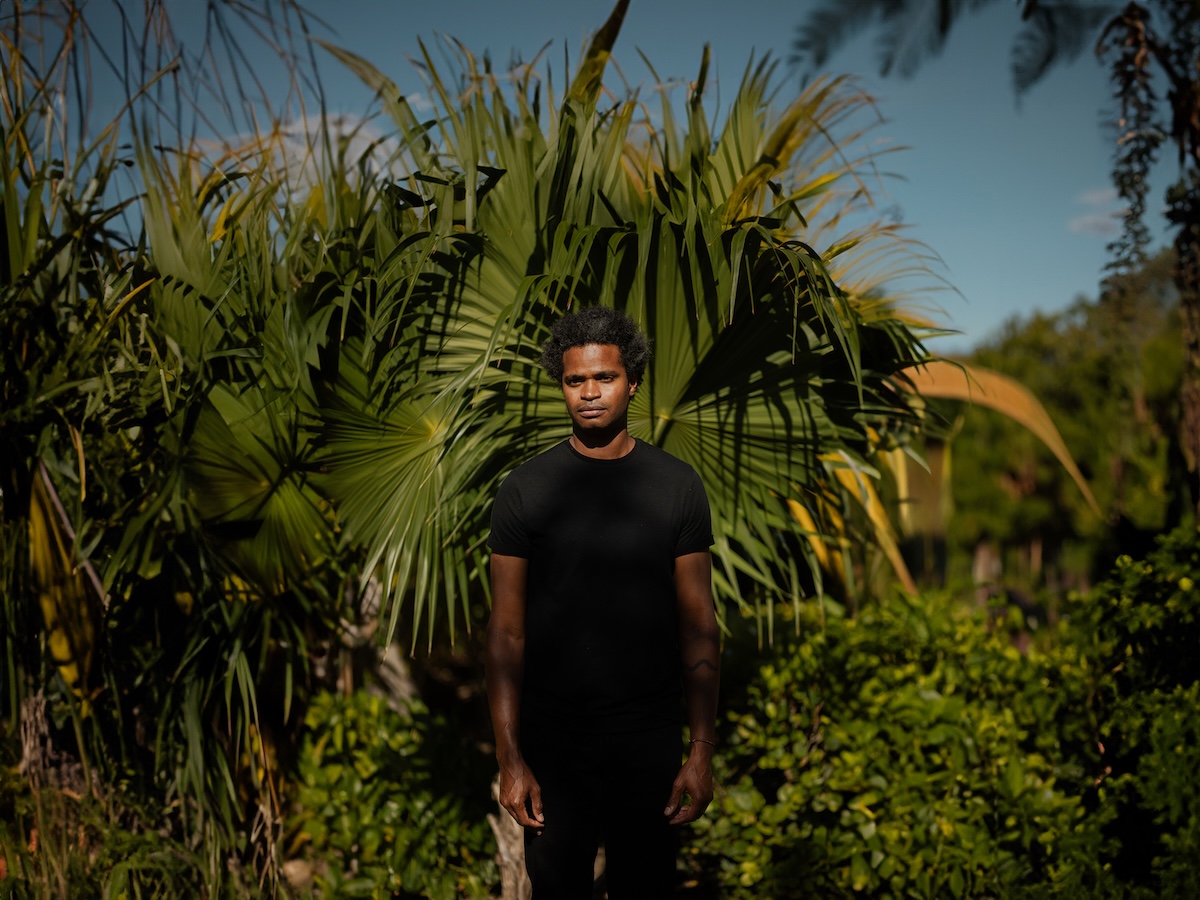
Featured image credit: photo by Blair J Meadows augmented by Rodell Warner
Visit Rodell’s website here: https://cargocollective.com/rodellwarner