
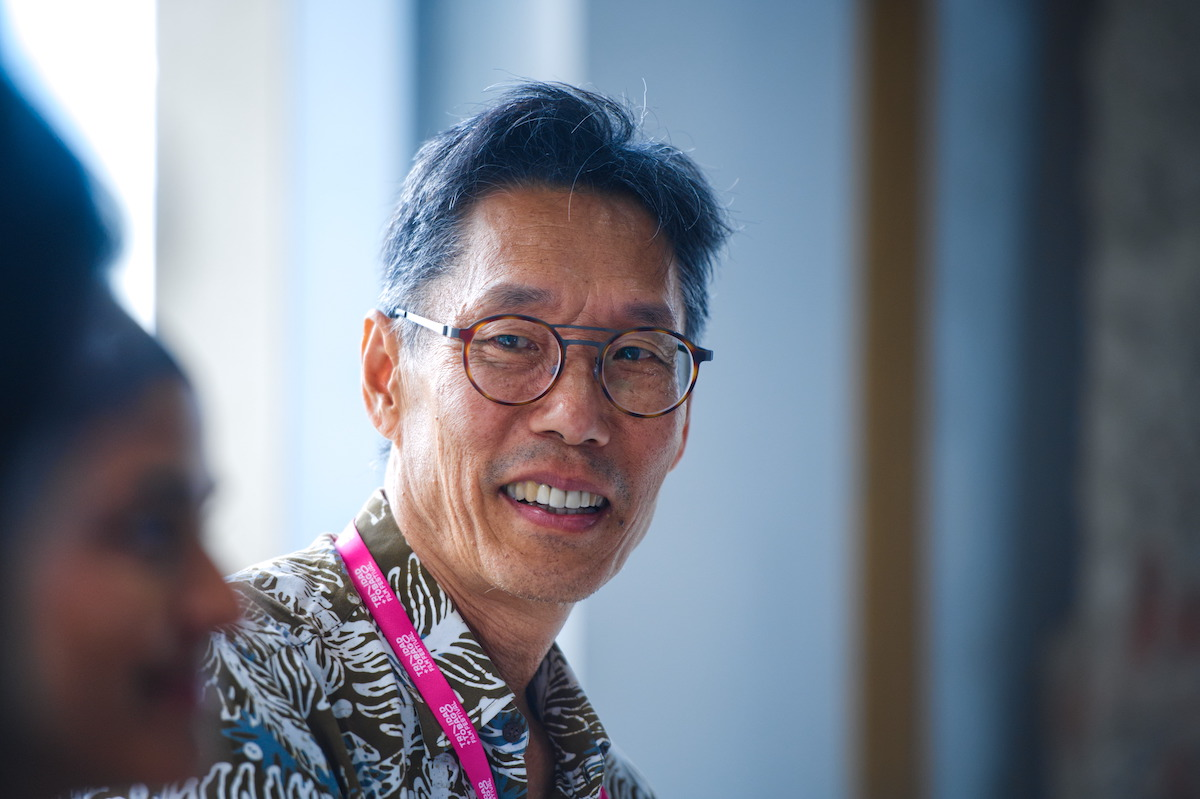
Written by Farrah Rahaman to mark the TTFF/25 retrospective look at Fung’s career in film and video.
“I have hot foot, my mother has hot foot,” Richard Fung says to me about his itinerant condition. The filmmaker, now 71, lives in Toronto where he has spent over four decades writing, making films, organising, agitating, and teaching.
Born in Port of Spain in 1954, Fung lived in Trinidad until a brief stint in Ireland for secondary school. In 1973 he joined his family in Toronto, Canada. He started his undergraduate studies in geography before changing course to Photoelectric Arts, exhibiting a joint attention to the politics of space, movement, and image, which has come to define his practice and body of work.
His films are rich entanglements with identity, place, family, and memory. To put a finer point on it, he is concerned with queerness, love, illness, connection, and displacement. He tracks who keeps our memories, how we survive and make meaning and home alongside one another, be it through food, artistic production, oral history, or cultural organising.
The locus of his work orbits mostly between his home places in Trinidad and Canada, though he traces the indentured routes in India and China and has made work about Palestine. “I am interested in understanding the world and what I do, and its limitations in terms of seeing,” he says in our conversation.
In the early 1980s, Fung cut his teeth contributing to emergent art and politics publications alongside other Trinidadian writers in the Canadian diaspora including M. NourbeSe Phillip, Ramabai Espinet, and Dionne Brand. Fuse Magazine became an intellectual nesting place for working out issues of cultural appropriation, marginalised identity, queerness, censorship, and risk, “a lot of my thinking went through there,” he reflects to me.
“I still have a nostalgic relationship with Trinidad copy books, so all my projects are in copy book form. I have such crapaud foot writing that I can never read what I wrote. But maybe the act of writing them down goes in somewhere,” Fung recounts in a giggle.
There were major moments in Fung’s politicisation. In Trinidad, growing up in a time of Black Power he began to see himself as Chinese in relation to Black and Indian Trinidadians, within a larger web of hierarchy and resistance. In Canada, he formed a respect and solidarity with indigenous activists turning his awareness to the ongoing settler colonial violence of the state and the native-led sovereignty efforts. Attending the first National March on Washington for Lesbian and Gay Rights in 1979 lit a fire under him. Upon his return home, he spearheaded the Gay Asians of Toronto or GAT, which was the first collective for racialised queer Canadians.
In 1984 he made his first professional video, ‘Orientations: lesbian and gay Asians’ arising from his organising work with GAT. Shot entirely on VHS, he still refers to his works during that period as videotapes, rather than films, foregrounding the recording apparatus itself – that narrow plastic tape coated with metal oxide which made so much more possible and accessible.
The video was intended to be a document for cultural organising, though it soon picked up traction on the art circuit, screening at the Flaherty Film Seminar and other exhibition and festival spaces. Early in his filmmaking journey, while traveling with ‘Orientations’, Fung was introduced to the work of the Black Audio Collective and the Black British filmmakers and cultural practitioners working at the time – Isaac Julien, Kobena Mercer, Lina Gopaul, John Akomfrah and Stuart Hall (1). He credits their influence on his work in the following years as foundational.
Three decades later thinking with Hall in the extended “‘play’ of history, culture and power” (2) ‘Re:Orientations’ (2016) rewinds and revisits the earlier tape with seven of the original fourteen characters reflecting on the changes in their lives and the wider world since that initial encounter. ‘Re:Orientations’ shows how identities are in a process of “constant transformation” belonging “to the future as much as to the past.”(3) Fung therefore, is interested in the long bend of time.
The turn of the 1980s marked an especially prolific period for the filmmaker, one in which his various selves and urgencies poured out onto the screen. In 1990 alone he released four documentaries, among them the oral history feature, ‘My mother’s place’, and ‘Out of the blue’ a short about the wrongful arrest of Julien Didier, a Black Canadian man apprehended for a crime he did not commit, in addition to two films about the wellbeing of gay Asian men.
Through ‘My mother’s place’ Fung shapes a picture of his mother Rita “too real, too contradictory, too whole.” We glimpse the innocence of a boy, bright-eyed and spirited, told in the gauziness of home video, and in the self-referential directorial voice revealed between moments of interview, observational, and archival footage.
Made with the intent to de-stigmatise and draw awareness to the epidemic, ‘Fighting chance’ (1990) is a testimony of four Asian men living with HIV. As a counterpoint, ‘Steam clean’ (1990) is an erotic ‘public service announcement’ where a South and East Asian gay couple have protected sex on camera. Taken as a diptych, they work together in service of pleasure and safety.
In his 1991 essay “Centre the Margins” Fung writes, “Many Asian or gay and lesbian tapes and films are still guided by notions of “positive images.” To the extent to which positive images are a response to negative stereotypes, it is a limited strategy in that it takes its cue from what the white man or what the straight man thinks….” (4)
Historically speaking, well-trodden narratives about marginalised identities prioritise white spectatorship. Fung’s work while hovering around the representative does not stay stuck in the inclusionary box. He is unconcerned with creating corrective portraits of Queer, Asian-Canadian, Trinidadian, or Palestinian people to redeem their humanity for white audiences. He moves easily through and past that first layer of representation as corrective, into something abundantly more sincere, and consummate.
This idea of centering the margins echoes with Toni Morrison’s insistence on the primacy of our subject positions. In response to an interviewer who foolhardily asked the author if she was ever going to write about white people Morrison answers, “I stood at the border, stood at the edge and claimed it as central, and let the world move over to where I was.” (5)
Fung learnt this strategy from his time working in community and local TV settings soon after graduating university. Narrowcasting was purposeful, almost surgical. It was okay to make a tape for 5 people if it meant something to them. Making meaning is about precision.
This approach is imbued with the kind of assimilationist refusal that the Yellowknives Dene First Nation scholar Glen Sean Coulthard champions in his work Red Skin White Masks (6). By extending the framework of Frantz Fanon, Coulthard shows how the abiding colonial violence between the Canadian state and Indigenous peoples can simply never be reconciled or repaired through processes of formal recognition. Similarly, inclusionary impulses in cinema and media would come up null in the pursuit of liberation. Coulthard underscores an alternative politics—one that seeks to revalue, rebuild, and deploy Indigenous cultural practices based on self and community connection rather than on seeking legal and cultural recognition from the settler state. Such a self-emancipatory strategy of personal and communal identification is evident across Fung’s practice.
“The talking head, or the documenting ordinary people speaking is always a thread in my work” he remarks. There is a power in the intimacy of direct address. He is frequently trailing alongside his participants, tracking their motions, following their stories.
Rather than a simple charting of another’s life story, his presence is contrapuntal – questioning, noting, observing, and leaving room always for the protagonists. Fung shows a well-tuned proprioception – that awareness of the position of one’s body in relation to other bodies and objects.
As he tells it, “When I do work on my family, I’m part of that family.” ‘Sea in the blood’ (2000) is an elegiac film about living in the orbit of illness, both of his older sister Nan, and his partner Tim. He works from the rupture of Nan’s death and sutures tenderness at every turn – in the narration over home tapes, photographs, and memories of the buoyant and strong-willed Nan. On a shallow sea floor through the amber sunlight, we see Fung gliding towards the camera, arms outstretched and lithe appearing in between and out of Tim’s legs. Fung helps us to locate the edges of ourselves and where they meet other people.
Autoethnography was a term bestowed upon him by Eve Sedgewick and José Esteban Muñoz, one that he found purchase in over the autobiographical; his approach more grounded in close relationship to his subjects, keen-eyed to the ebb and flow of power and the bearing this has on speech.
Fung uses his own memories as grounding points. “When I was a child, my family went to the Starlite Drive In. I vaguely recall that we would get a treat or discount from the person working there. This would have been Nang,” he recounts in the 2016 film, ‘Nang by Nang’, spotlighting Fung’s elder cousin. We journey with her across husbands, vocations, and cities through her spell as a dancer with Geoffrey Holder, her life as a palliative care nurse, tracing her origins in Moruga, and time in Port of Spain and Guanapo, Venezuela, New York and New Mexico.
Nang is not hemmed in by her losses but spry, brimming, larger than life. Perhaps one of my favourite things about his films is his habit of gentle endings. Often Fung cedes the last word to his subjects, softening into the world in which we find them. “So many changes have turned into my life it isn’t funny” she says positioned behind the steering wheel. He shows Nang in her eighties, still in the driver’s seat, calling the shots.
‘For Colin’ is a short film made for his friend, the late poet, cultural producer, and Trinidadian activist Colin Robinson. It is a stop motion elegy told through one of Robinson’s poems. As the founder of CAISO: Sex and Gender Justice Robinson played a major role organising for the decriminalisation of homosexuality in Trinidad, which devastatingly was recriminalised this year after a 7-year stretch of progress. Robinson had his own experience in filmmaking as the field producer on Marlon Riggs’ canonical ‘Tongues untied’ revealing another portal relationship between cultural organising, artistic expression, and fellowship.
While Fung has not intentionally set out to document the lives and work of other artists, these loose portraits are a major feature of his work. ‘Uncomfortable: The art of Christopher Cozier’, meets the artist at a time when contemporary art in Trinidad was a less legible endeavor than it is today. At home with his family and in his studio space, he is presented as a bit heterodox and unpretentious. Fung registers Cozier as a vanguard – impressing a conceptual mastery that undercuts the elitism of the global art world and well-to-do Port of Spain society. He is shaped by both, and in the end remains comfortably unabashed by them.
His most recent film, ‘The enigma of Harold Sonny Ladoo’ (2024), which will have its Caribbean premiere at this year’s festival, is a look at the writer’s mythic life. Taking up the mantle of Christopher Laird’s archival work on Ladoo, Fung reassembles the fragmentary 20-year-old body of footage by gathering a chorus of Trinidadian writers, and additional testimonies from the writer’s family members and friends.
Fung is concerned about the Caribbean’s centrality in the ‘modern’ world forged from the continental drift and pull of people across Africa, Asia, Europe, and the Americas. In ‘Dal puri diaspora’ (2012) he maps how roti traveled with indentured Indians from 18th century Bihar to colonies in the Caribbean and Mauritius. In its discussion of labour, extraction, cultural retention, and hybridity, it does what food writing does at its finest – it is surface and it is depth, hitting the palate: sweet, sour, bitter, hot. My perhaps free-swinging opinion is that it is the most important documentary we have about Indian indenture in the Caribbean.
Counting among Palestine’s many steadfast defenders, Fung has advocated for liberation through documentary, experimental work, and organising efforts. In 2007, he made ‘Jehad in Motion’ a two-channel portrait of his friend Jehad Aliweiwi moving through Hebron, his city of origin, and Toronto, where he has migrated and made a life.
“I feel like I’m two different people living in distinctly dissimilar worlds” Jehad shares in the film. Fung takes the fragmenting condition of Jehad’s exile and split screens him as if to air out the wound rather than improperly dress it. He described his time filming with Jehad to me. “In Palestine you see ancient olive trees, you see the rootedness to a land and the beauty of Palestinians. This is what’s at stake,” he says.
The seed of the project was a sound piece Fung made in 2003, Installation with F-16s, Apache Helicopters and Rock Doves, which responded to the aerial bombing Israeli Occupation Forces wrought on Palestinian civilians. For strikes to occur, the occupied airspace would need to clear up, so the waning din of the F-16 Apache helicopters would signal imminent bombing. Palestinian children responded in terror to the silence, so their parents would turn up the radio volume to fill in the eerie gap. The radio, in a Pavlovian association, became connected with the attacks. The constant droning would fade to quiet; the radio blares then boom. Fung was emphasising the cyclical terror unleashed by Israelis and how this seeped into the sensing and feeling space of parents and children alike.
In the essay “Uncompromising Positions” (1997) Fung writes, “The regulation of expression is accomplished by the everyday practices of thousands of decision-makers, from petty to powerful, simply doing their jobs. This includes the self-censorship of cultural producers themselves.”
“Now I think my role is not to represent Palestine, but to help circulate those works made by Palestinians especially,” he says. “Because there is so much work from experimental to fiction to documentary” and with the ongoing genocide there is now too “the realisation of how important the circulation of images produced from Palestinian subjectivities is.”
Today, Fung organizes as a media worker with Canadians for Justice and Peace in the Middle East and serves on the advisory board of the Palestine Toronto Film Festival where this year he is also a programmer. His ethical commitments point us to the distance between what we are doing, and the freer conditions we desire in the world. Fung is tending to this distance, closing it little by little, in the everyday.
Journeying across broad geographies and themes, his relationships, it seems, are his anchors. When we speak, he asks questions about my own experiences and what I’m working on. We spend almost the first hour directed towards me. He is a rolodex of other scholars, archivists, curators, programmers, putting me on to his friends and peers thinking alongside and akin my own questions.
His work is a companion to me, guiding me through a gap in my own subjectivity – a gap that I inhabit in the both/and of home and away. Some of his last words from ‘My mothers place’ pool around me, I feel their tidal pull.
“Asked from one generation to another, these questions can never be satisfied. Still, I need her answers. Sometimes practical things like how to burn sugar or when to stir the callaloo. My mother connects me to a past I have no other way of knowing. In a sea of whiteness, friends, enemies, strangers – I look at her and know who I am.”
.
ENDNOTES
1) Fung met the former two figures through his teacher Kay Armatage.
2) Hall, S. (1990). Cultural Identity and Diaspora. In J. Rutherford (Ed.), Identity Community, Culture, Difference (pp. 222-237).
3) Same as above.
4) Fung, Richard. “Centre The Margins” in Russel Leong (Ed.), Moving the Image: Independent Asian Pacific American Media Arts, pp. 62-67. Los Angeles: UCLA Asian American Studies Center & Visual Communications, 1991.
5) Morrison responds to the white Australian interviewer Jena Wendt. Source: Deans, G., Hall, A., Wendt, J., & Morrison, T. Toni Morrison Uncensored. Films for the Humanities & Sciences. 1998.
6) Coulthard, Glen Sean. Red Skin, White Masks: Rejecting the Colonial Politics of Recognition. Minneapolis: University of Minnesota Press, 2014.